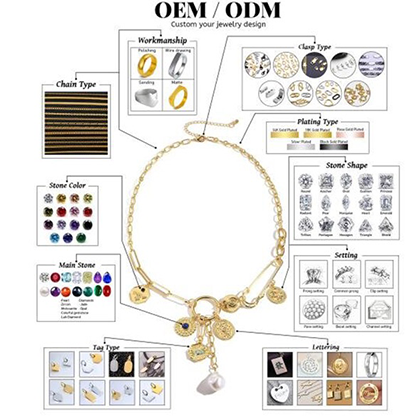
This initial phase transforms client concepts into producible designs. Manufacturers analyze sketches and mood boards for structural feasibility, material limitations, and cost implications. Using CAD (Computer-Aided Design) software, they convert artistic visions into millimeter-precise technical blueprints while advising on adjustments for durability and wearability. This collaborative engineering stage prevents costly revisions later by resolving design-manufacturing gaps upfront.
Once designs are approved, fabrication begins. Lost-wax casting remains prevalent for intricate metal components, while 3D printing enables rapid prototyping of complex geometries unachievable through traditional methods. Leading manufacturers combine these approaches—using printed resin patterns for investment casting—to balance detail resolution with volume production. This hybrid methodology allows wholesale custom jewelry manufacturers to maintain quality across batches while accommodating unique design elements.
Post-fabrication processes determine final aesthetics and integrity. Stones are precision-set, surfaces receive hand-polishing or specialized finishes like rhodium plating, and components undergo assembly. Each piece passes through 4–6 quality checkpoints: dimensional accuracy verification, stone security testing, clasp functionality assessments, and finish durability inspections. Crucially, ethical wholesale custom jewelry manufacturers document compliance with the Responsible Jewelry Council (RJC) Chain-of-Custody standard, ISO 9001 quality management systems, and EU REACH chemical regulations—ensuring responsible material sourcing and production transparency for international distribution.
Wholesale custom jewelry manufacturers typically provide three primary service frameworks: Original Equipment Manufacturing (OEM), Original Design Manufacturing (ODM), and private label solutions. Understanding these models is essential for aligning production strategies with your brand’s development phase and technical capabilities.
Emerging designers often benefit from ODM arrangements, where manufacturers supply existing catalogs for customization—reducing R&D costs by 30–50%. Growth-stage brands with proprietary designs typically leverage OEM services, retaining full intellectual property control while outsourcing production. Established enterprises seeking inventory efficiency may prefer private label options, applying their branding to manufacturer-designed collections. Late-stage brands can combine models: OEM for signature lines and ODM for seasonal collections.
Minimum Order Quantities (MOQs) directly impact unit economics, with entry-level custom orders starting at 50–100 units (costing 20–30% more per piece than 500+ unit runs). Complex designs extend lead times by 10–20 days due to mold development and multi-stage quality checks. Manufacturers scale operations through:
| Production Factor | Startup Tier (≤100 units) | Growth Tier (500 units) | Enterprise Tier (5k+ units) |
|---|---|---|---|
| Avg. Lead Time | 45–60 days | 30–45 days | 15–30 days |
| Per-Unit Cost | $12–$25 | $7–$15 | $3–$10 |
| Tooling Fees | $150–$500 | Waived at 500+ units | Fully subsidized |
Volume incentives enable 40–60% cost reductions at higher tiers, though intricate designs add 15–25% to all pricing brackets. Always confirm ethical certifications—including RJC Chain-of-Custody—during capacity negotiations.
Selecting the right manufacturing partner requires meticulous vetting across four strategic dimensions. First, confirm material-specific expertise—a manufacturer skilled in mass-produced silver chains may lack precision for complex gold filigree or enamel work. Request case studies showing intricate customization like layered pendants or micro-pavé settings. Second, evaluate scalability: demand 30-day production forecasts and verify third-party certifications like RJC and ISO 9001 for ethical sourcing and quality assurance. Third, test communication protocols; leading suppliers offer digital dashboards tracking design iterations, reducing revision delays by up to 40%. Finally, insist on physical samples before bulk orders—a 2023 Jewelers Board of Trade report noted inconsistent casting quality caused 29% of startup failures.
| Vetting Dimension | Critical Assessment Criteria | Verification Method |
|---|---|---|
| Expertise | Material specialization, design complexity capability | Portfolio review, sample inspection |
| Scalability | Peak-season capacity, ethical certifications (RJC, ISO) | Audit production schedules, request certificates |
| Compliance | Metal purity standards, REACH chemical regulations | Third-party assay reports, compliance documentation |
| Collaboration | Digital proofing tools, revision cycle time | Mock project trial, platform demonstration |
Implementing digital collaboration platforms significantly minimizes friction between brands and wholesale custom jewelry manufacturers. Shared dashboards provide real-time visibility into production milestones, material sourcing, and compliance documentation—reducing email delays by 40%. Key features include:
These systems create audit trails for intellectual property (IP) protection while maintaining transparent communication channels. Revision histories document every modification request, establishing clear accountability if disputes arise. For optimal results, define protocol triggers upfront—such as mandatory design freeze points before casting—to prevent costly mid-production alterations that impact lead times.
Q1: What are the primary service models offered by wholesale custom jewelry manufacturers?
A1: The three main service models are Original Equipment Manufacturing (OEM), Original Design Manufacturing (ODM), and private label services. These models cater to different brand needs and stages—for example, ODM suits emerging designers, while OEM is ideal for growth-phase brands with proprietary designs.
Q2: What are the common lead times and costs associated with MOQs?
A2: For startup tiers (≤100 units), lead times are 45–60 days with unit costs of $12-$25. Growth tiers (500 units) have 30–45 days lead time at $7-$15 per unit, while enterprise-level orders (5k+ units) have 15–30 days lead time with $3-$10 per unit cost.
Q3: How do wholesale manufacturers ensure ethical compliance and quality?
A3: Ethical compliance is ensured via certifications like the Responsible Jewelry Council (RJC), ISO 9001 for quality management, and adherence to EU REACH chemical regulations. Quality is maintained through multi-stage inspections and strict testing protocols.
Q4: What digital tools are used for collaboration in jewelry manufacturing?
A4: Manufacturers use digital dashboards and proofing tools for real-time production tracking, revision management, and compliance documentation. These platforms reduce delays and ensure transparent communication between parties.

 EN
EN
 Hot News