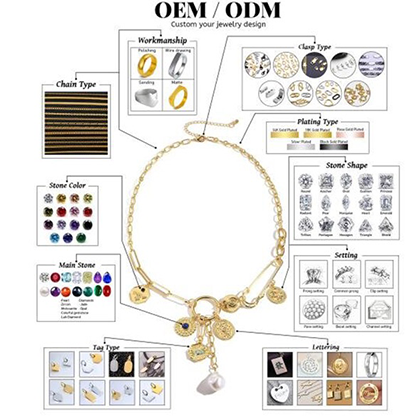
Factory direct jewelry sourcing dismantles traditional multi-tiered distribution by establishing direct manufacturer partnerships. This model bypasses wholesalers, distributors, and third-party retailers who collectively add 45–65% markups, according to industry analyses (2023). By transacting directly with verified production facilities, brands eliminate these hidden costs while gaining real-time price transparency.
Conventional jewelry distribution involves 4–6 intermediaries between mines and consumers. Each entity—from casting houses to luxury retailers—adds margins averaging 15–25% per link. These cumulative markups inflate consumer prices by 200–300% above true production costs. Importers alone charge 10–20% for logistics and compliance paperwork, while designer labels may add 100%+ brand premiums. Such opacity obscures actual material and labor expenses, making cost benchmarking impossible for retailers.
Eliminating intermediaries enables direct savings of 30–50% on COGS (Cost of Goods Sold). Brands report a 40% average reduction in gold and silver sourcing costs when contracting factories directly. A 2024 wholesale jewelry study confirmed that retailers using direct-purchasing models achieve 51% higher gross margins than peers relying on traditional channels. These savings stem from:
Independent brands using factory-direct models reinvest 34% of these savings into higher-quality gemstones or sustainable certifications—without raising retail prices.
Factory direct jewelry partnerships dismantle supply chain opacity by enabling direct access to verified manufacturers’ pricing structures. Retailers gain precise visibility into COGS components—from raw material expenses to labor costs—through digital dashboards that track production in real-time. This transparency allows businesses to benchmark expenses against market averages and negotiate based on actual data rather than estimates. One mid-sized retailer identified 17% hidden fees in their legacy supply chain after implementing factory-direct sourcing protocols, funds subsequently reallocated to sustainable material upgrades.
A prominent U.S. jewelry e-tailer demonstrated the financial impact of this model by transitioning from traditional wholesalers to verified factory partners. By eliminating three intermediary layers and implementing real-time production monitoring, they reduced per-unit COGS by 34% within 18 months. Key savings came from:
This restructuring expanded their gross margins from 42% to 61% while maintaining identical retail pricing—proving how factory direct jewelry models convert transparency into measurable profitability.
Eliminating distributor markups—which typically consume 20–40% of retail revenue (Financial Models Lab 2023)—directly converts into profit growth for retailers adopting factory direct jewelry partnerships. Traditional multi-tier distribution channels force retailers to absorb cumulative margins at each step: raw material suppliers, wholesalers, logistics providers, and storage facilities. In contrast, direct sourcing allows retailers to:
| Profit Lever | Traditional Model | Factory Direct Impact |
|---|---|---|
| Intermediary Fees | 20–40% markup | Eliminated |
| Inventory Holding | 8–12% overhead | Reduced by 60–70% |
| Order Flexibility | High minimums | Customizable MOQs |
This strategic reconfiguration transforms cost savings into sustained margin expansion—particularly vital for retailers scaling lab-grown diamond collections, where transparency compounds customer trust. Real-time production oversight further enables rapid response to market trends, turning inventory efficiency into a recurring profit accelerator.
Factory direct jewelry partnerships enable real-time design adjustments through immediate manufacturer feedback loops. This eliminates traditional back-and-forth with middlemen, accelerating prototyping cycles by 40–60% compared to conventional models. Jewelry brands gain unprecedented customization control—from alloy compositions to intricate stone settings—while benefiting from reduced minimum order quantities (MOQs). Flexible production thresholds allow emerging designers to test collections with batches as small as 50 units, dramatically lowering inventory risks. Responsive workflows mean seasonal trends can be incorporated within weeks rather than months, ensuring market relevance.
Direct factory relationships establish comprehensive material tracking from raw mineral sourcing to final polishing stations. Blockchain-enabled documentation systems provide immutable records of conflict-free gemstone origins and recycled metal content, exceeding FTC compliance requirements. Production partners undergo rigorous SMETA audits evaluating fair labor practices and environmental safeguards like water recycling rates. This vertical oversight prevents ethical violations common in fragmented supply chains—where subcontracting obscures working conditions. Retailers using factory direct jewelry models report a 98% reduction in consumer concerns about ethical provenance.
Factory direct jewelry sourcing involves partnerships with manufacturers to bypass traditional intermediaries and reduce costs, ensuring price transparency and direct negotiations with production facilities.
By eliminating intermediaries and associated fees, retailers can achieve direct savings of 30-50% on production costs and improve gross margins by 51% on average.
Real-time production monitoring provides transparency in cost of goods, allows for direct negotiation based on actual data, and enhances quality control and ethical sourcing.

 EN
EN
 Hot News