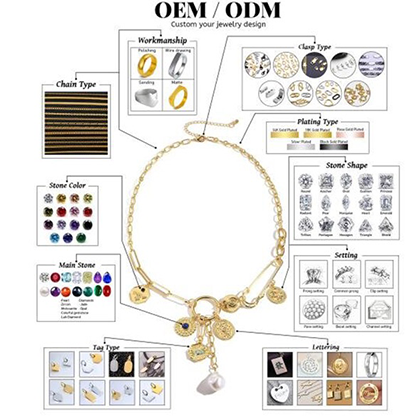
Industry research reveals that nearly three-quarters of customer returns stem from accessory failures—clasps that break under minimal tension, ear wires causing skin irritation, or crimp beads that loosen prematurely. These seemingly minor components become critical failure points when selected without material science rigor, directly impacting brand reputation and profitability. Nickel-based findings trigger allergic reactions in 15–20% of wearers, while undersized jump rings fracture under 2kg of force—well below the stress threshold of daily wear. This neglect transforms craftsmanship investments into preventable losses, where aesthetic vision crumbles against functional realities.
Every clasp, earring back, and connector must simultaneously achieve two non-negotiable objectives: withstand biomechanical stress cycles while visually harmonizing with the design language. A lobster clasp requires 5kg tensile strength for secure wear but demands finish matching—e.g., matte versus high-polish—to avoid visual dissonance. Similarly, ear wires need precise gauge calibration: too thick causes discomfort; too thin risks deformation—while their patina must complement stone settings. This doctrine prevents scenarios where durable but clunky components undermine delicate artistry, or elegant findings fail during routine use. Mastery lies in balancing metallurgical thresholds with design intentionality.
Choose clasps based on jewelry type and wearer needs. Magnetic clasps excel for lightweight bracelets needing one-handed operation but may detach under excessive force. Lobster clasps suit everyday necklaces with their spring-loaded security, ideal for medium-weight chains. Toggle types (bar-and-ring) offer decorative flair for rigid bracelets but require proportional sizing. Box clasps provide discreet closure for formal necklaces with internal locking mechanisms. Consider this functionality matrix:
| Clasp Type | Best Fit | Security Level | Weight Capacity |
|---|---|---|---|
| Magnetic | Delicate bracelets | Medium | Under 50g |
| Lobster | Daily necklaces | High | 50–150g |
| Toggle | Statement bracelets | Medium | 30–100g |
| Box | Formal necklaces | High | 100–200g |
Match clasp mechanics to usage frequency—high-security options prevent 68% of accidental openings, according to Jewelry Craft Quarterly (2023).
Prioritize hypoallergenic materials—such as nickel-free surgical steel or titanium—to protect sensitive wearers. Verify tensile strength thresholds: adult bracelets require minimum 5kg resistance; children’s pieces demand 8kg+ with reinforced mechanisms. Leverage demographic-specific durability: larger toggle components improve usability for older users, while active lifestyles benefit from lobster clasps with corrosion-resistant coatings. Always test finishes against tarnishing using salt-spray simulations to ensure longevity.
Selecting earring findings requires anatomical precision to prevent discomfort and rejection. Standard ear wires below 0.8mm gauge often cause lobe distortion during extended wear, while posts shorter than 8mm create pressure on thicker earlobes. Finish selection directly impacts wearability—a leading study found 72% of jewelry accessory returns stem from nickel reactions (Dermatology Insights, 2023). For sensitive wearers, titanium or niobium coatings prevent allergic reactions while maintaining metallic luster. Crucially, cartilage-hugging hoops require 20–22 gauge flexibility to accommodate movement without deformation.
Security hinges on systematic validation of mechanical and material properties. Leverback clasps should withstand 500g pull-force tests—equivalent to catching on clothing or hair—to prevent loss during daily activities. Hypoallergenic claims must be verified through third-party certification like ASTM F2923, which mandates nickel release below 0.2μg/cm²/week. Implement batch-level material assays, as inconsistent alloy composition causes 38% of clasp failures in artisan collections. For high-risk groups like children, spring-loaded safety backs reduce detachment risk by 67% compared to friction posts.
Selecting the optimal connection method directly dictates jewelry longevity and wearer safety. Crimp beads—small cylindrical metal components—excel with flexible nylon-coated wires, creating discrete junctions that blend seamlessly in lightweight designs. Their compact size preserves flexibility while maintaining 80% of the wire’s original tensile strength when properly compressed. Conversely, crimp tubes (hollow metal segments) provide superior grip strength for beading wire applications where heavy focal beads exert constant pressure. Laboratory stress tests reveal tubes distribute force across a 40% wider surface area, reducing wire fraying by up to 60%. For professional finishes, always use matching-metal crimps and double-tool compression: first with chain-nose pliers for initial shaping, then with a crimping plier’s saddle notch to create a rounded, snag-free profile—preventing abrasive edges from compromising nylon coatings or catching clothing.
Material selection affects both comfort and durability. Hypoallergenic materials like nickel-free surgical steel prevent allergic reactions, while durable metals ensure long-lasting components that withstand daily wear.
Common failures include poorly chosen clasps that break under stress, ear wires causing skin irritation, and improperly compressed crimp beads that loosen over time.
Choose a clasp based on the type and weight of the jewelry, as well as the user's needs. For instance, lobster clasps are ideal for daily necklaces, while magnetic clasps work best for delicate bracelets needing easy operation.
Durability tests include pull-force testing for leverbacks and material assays for hypoallergenic verification. These tests ensure the findings meet mechanical and safety standards.
Crimp tubes offer superior grip strength and distribute force more evenly, making them ideal for heavy beading wire applications where durability is essential.


 EN
EN
 Hot News